Sunday, January 29, 2012

Tropical Parula - Quinta Mazatlan

I initially found a Tropical Parula at Quinta Mazatlan on December 17, 2011. I went to Quinta looking for a Tropical Parula, I admit, because one has wintered there the last couple of years, feasting on the oranges at the feeding station. I presumed the Tropical Parula was a male because it was singing, and an adult because the head was blue and not green. Here it is, from that day: Today as a part of regular research at Quinta Mazatlan, the Tropical Parula was captured and banded. Lo and behold, it's an adult female. The age of the bird was determined using Pyle (1997). The primary coverts are broad, in good condition, and edged with blue. The tail feathers are broad. The bird was sexed as a female by the dark blue cheek and lores, not the black of a male. It looks from reports as though there has been a Tropical Parula at Quinta since it was initially found. So if this is the same bird that appeared on 12/17 why was it singing then? It's a very pretty bird, and it will be interesting to see if she comes back next year. I sure hope so!
Thanks to Mark Conway, the Master Bander operating this station, for allowing me to band with him, and Mary from Minnesota for loaning me a Nikon battery when both my cameras died!

Tuesday, January 24, 2012

Cheryl Delashmit's Photo - Purple Sandpiper, Port Mansfield, TX, January 23, 2012 - Willacy County

Here is a photograph taken by Cheryl Delashmit of the Purple Sandpiper she and her husband found at Port Mansfield, TX (Willacy Co.) on 1/23/2012. This is a first for Willacy County, and one of fewer than 25 records for Texas. I've taken the liberty of cropping the photo, and I provide the crop below the full size image.

Sunday, January 22, 2012

RGV Tracks and Signs - La Sal del Rey, December 20, 2011

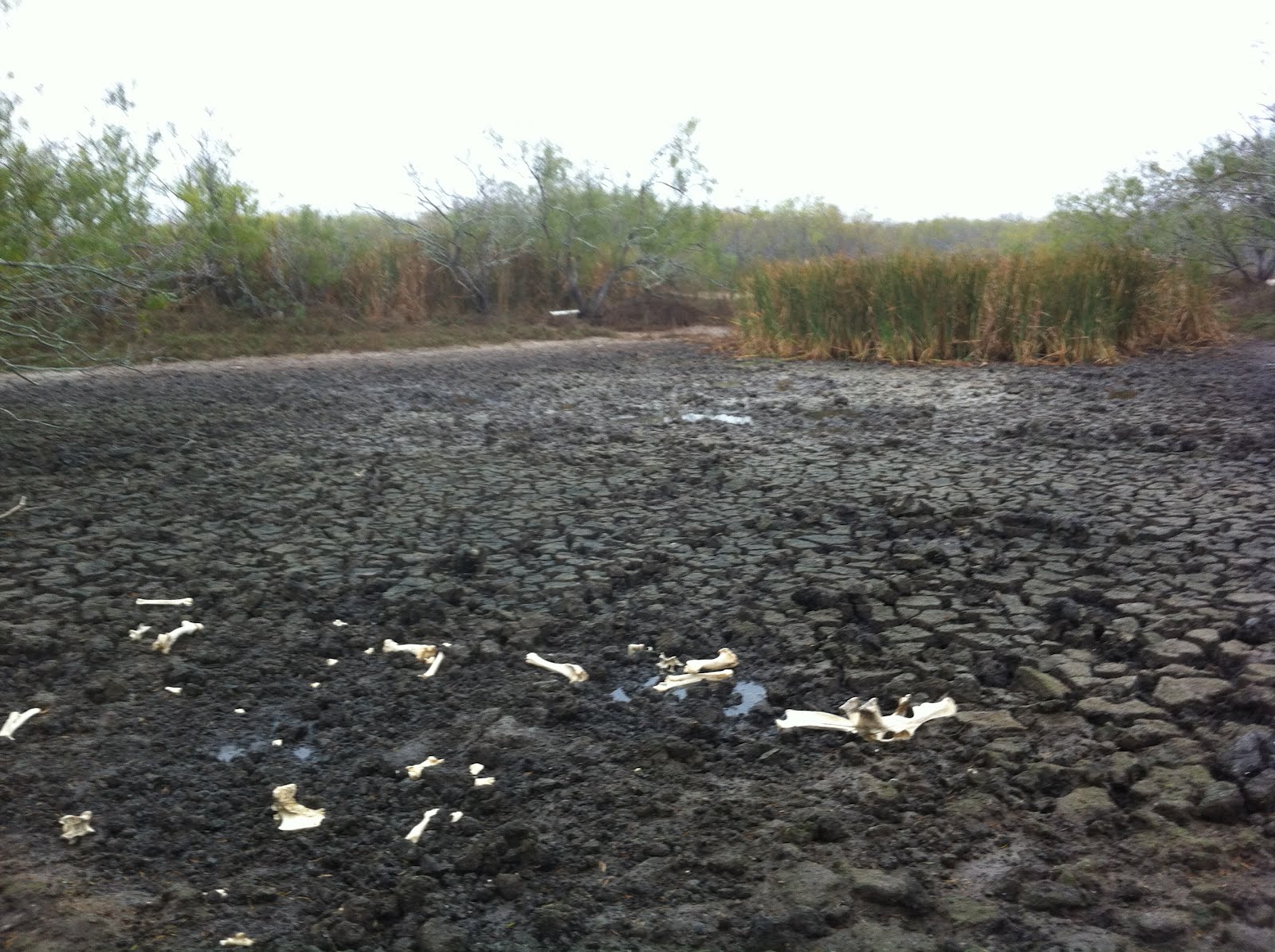
Here's some photos of tracks and signs at La Sal del Rey, USFWS NWR tract. I took these pictures while covering the area on the La Sal Vieja Christmas Bird Count. The salt lake was nearly dry, but was still heavily used for roosting by Sandhill Cranes, Greater White-fronted and Snow Geese. A freshwater spring held the skeleton of a nilgai, an introduced and established ungulate native to India. Nilgai can be more readily observed elsewhere; I've seen more dead animals at La Sal del Rey than live animals. Nilgai are common throughout south Texas.
The skull was partly broken. It was not nearly as heavy or large as a cow skull, but larger and stouter than a white-tailed deer.
Nilgai tracks were all over the lake shore.
Here's the tracks of a coyote on the beach. I watched a pair playing on the sand in the distance. A freshwater spring is the focus of wildlife activity in that saline and arid environment.
The coyote and nilagi tracks were overlapping on the beach. Nilgai are far to large to be prey for the omnivorous coyote, but all the animals were using the spring as a water source. Nilgai use communal feces piles. These are small fecal piles, but the largest I saw on the beach. They are always at the center of a web of tracks of nilgai coming and going. There were a lot more nilgai tracks, with calves skittering and bucking near cows. And yes, I did look up and find some birds, too!

Tuesday, January 3, 2012

Mountain Bluebird - Santa Ana NWR

Here's a couple of photos of the female Mountain Bluebird at Santa Ana NWR. The long winged profile (compared to Eastern Bluebird) is evident here, as is the sky-blue rump and tail. This is the first winter with Mountain Bluebirds in Hidalgo County since I moved here in 2006. The first birds found were a pair in San Juan that did not remain. There are several in western Hidalgo County as well.

Saturday, December 17, 2011

Eastern Towhee at Quinta Mazatlan

I went to Quinta Mazatlan after lunch today with the idea of taking a quick look around in the rain and then heading home quickly. One of the first flocks that I encountered had 3 Spotted Towhee (a male and two females) and this Eastern Towhee.
It was great to hear this bird "chewink"-ing near the mansion later in the afternoon. The towhee flock moved off and this Tropical Parula came in with a flock of Orange-crowned Warblers. At one point it nearly landed on me! Later I saw it feeding on the orange bars by the amphitheater. The yellow breast is very extensive, extending to the legs rather than ending on the upper breast as in Northern Parula; the yellow breast is lacking a crescent (again as in Northern) but rather has an orange wash across the breast. The pale around the eye is more visible in the photo than it was in the field. I have noticed other Tropical Parulas here losing the pale edgings through the winter. This bird sang a few times in a large live oak near the amphitheater.
A quick call to Dan Jones and he came over to look for the Eastern Towhee with success. As we were birding around, this Broad-tailed Hummingbird appeared at one of the feeders at the mansion. Not the greatest photos here in the rain, but the tail had broad blue-green central tail feathers and rusty edges on the outer tail feathers. The throat lacked color in the gorget, and the lores lacked any rufous. It seemed to duck into the feeder when the Buff-bellieds were away.

Friday, December 16, 2011

Eating Crow - Royal Tern in Hidalgo County

I'm known for being a cynic - I may not be from Missouri, but I like to see photos or descriptions when I'm told about rare birds. There are a few species that I hear reports of, but never see documentation. I've come to question the status of these birds within Hidalgo County, an inland county in Texas.

One such species is the Royal Tern. It's common on the coast, but that's an hour away. I have heard many reports of Royal Terns in Hidalgo County but never seen one myself. I had no idea I was in excellent company - long time local birder Dan Jones had a similar hole in his county list. Today, I called Dan Jones about a Bonaparte's Gull at the Donna Reservoir - and he paid me back with a call about a Royal Tern that he found when he went to look for the Bonie. I still think many reports of Royals in the county are begging juvenal Caspian Terns. Juv Caspians are still peeping and following adults in fall and winter when most Royal Terns are reported.You can see the long, narrow, orange-yellow bill; white forehead with black extending from eye to eye across the back of the head; clear white wingtips with a narrow black border on the trailing edge below; narrow wings throughout their length; and more forked tail compared to Caspian Tern.
___________________________________________________________________
Directions to the Donna Reservoirs - from US 83 on the west side of Donna, take FM 1423 (Val Verde Road) south to Business 83. Follow 1423 east to its continuation on Valley View Road south, which bisects the Donna Reservoirs. This is a good area for diving ducks, herons, egrets, swallows, and gulls and terns in winter.

Saturday, December 10, 2011

Surf Scoter at SPI - Until the Alligator ate it...

I was sitting at observation platform 7 watching the Pied-billed Grebes and ignoring the alligator this morning, when I saw a Surf Scoter swimming down the channel towards me. I was shocked to say the least as I was sitting in a fresh water marsh. I snapped off a few photos and my card filled up - just too many photo ops on the boardwalk! So I went to delete some images to free up space as the scoter kept swimming right at me. I looked down to delete another less than sharp Reddish Egret when I heard a loud splash. I looked up - no scoter. Also no alligator. I waited, and the alligator came to the surface with the scoter in its mouth. Now why couldn't it have grabbed a coot instead?
And the Hammond's Flycatcher was still at the Convention Center too.