Sunday, March 25, 2012

Thailand 1 - Do You Know the Way to Pak Thale?

Pak Thale is a series of salt concentration ponds about 3 hours drive south of Bangkok. And no, I don't know the way to Pak Thale - but the last turn before the salt ponds is signed with an image of a Spoon-billed Sandpiper! Spoon-billed Sandpiper is designated as Critically Endangered by the IUCN with an estimated breeding population in 2009-2010 of 120-200 pairs (or fewer). The causes of the continuing population decline were unknown until recent work showed that hunting on the winter grounds was likely the driving factor (see www.shorebird-network.net/PDFs/Sbs-WSG-article.pdf). We were at Pak Thale on February 28, 29, and 30, 2012 and I saw 31 species of shorebirds at Pak Thale.

Spoon-billed Sandpiper is an enigmatic small shorebird that is readily recognized when the distinctive spatulate bill is seen. One of the accessible places in the world to see them is Thailand, and Pak Thale has more individuals than other sites including Kohk Kham. The area is a salt works, so sea water is sent into shallow ponds where the water evaporates and the brine sent to yet shallower ponds, ending in the shallow sterile ponds where the salt crystals form and are harvested for sale. I'm hoping that the locals start selling "Spoonie Salt" to benefit the Sandpiper.
The Spoon-billed Sandpipers are a very small number of the thousands of shorebirds that gather in the salt ponds either to feed in the less salty shallow ponds, or to roost and await low tide on the adjacent mudflats. Here's a mixed flock of Great Knot, Black-bellied Plover, some peep (Rufous-necked Stint), Bar-tailed Godwit, sand-plovers, and who knows what all!
Here's a flock on the ground, both species of Sand-Plover, some in nice plumage; a Spoon-billed Sandpiper near the center (and another couple less obvious). Shorebirds were scattered all over the ponds, with the Eurasian Curlew in a large single-species flock - except for a couple of Far Eastern Curlews identifiable in flight. We
Here's a nice study of an Old World Great Egret in breeding color, with a black bill, blackish-red legs and a turquoise face. On one side is an Intermediate Egret with a short yellow bill (and a seriously great name!) and a Little Egret.

But the extension was named for the Spoonie, so the Spoon-billed Sandpiper was the star of the show. We worked hard on March 1 to find some Nordmann's Greenshanks (aka Spotted Greenshank). We'd been unable to access their favored roosting site due to salt workers and trucks working in the area at low tided, but we managed to walk in and find four birds roosting with Black-tailed Godwits on the last morning. But here's the star of the show in a digipic, we didn't press the birds.

Saturday, March 24, 2012

Thailand 1 - Introduction

My latest trip was atypical for my personal travel in several respects. Most of my birding trips to date have been in the Americas and have been with small groups of friends. I went to Thailand to join Jon Dunn and WINGS "Spoon-billed Sandpiper Extension" (after skipping the three week long main tour) and then continued on the "Peninsular Thailand and Gurney's Pitta" tour. I've never been on a commercial tour before, but it made a lot of sense this time. I didn't have time to plan a trip, I can't read or speak Thai, and I wanted to see as many birds as I could in my limited vacation time. I had three free days that I spent birding, two with Nick Upton of the Thai Birding website (http://thaibirding.com), and one with outfitter ETC (Educational Travel Center http://www.etc.co.th/).

So why Thailand? Here's three good reasons - the food, the people, and the birds. Who could argue with all those weird and colorful Asian birds? A more telling reason would be that I've heard Jon talk about Thailand for decades, and I decided to make the time to go this year.

So Thailand. I flew on miles on the now-defunct Continental, and was able to save considerable miles by flying from Houston to Frankfurt to Bangkok, rather than from Houston to Tokyo or Seoul to Bangkok. Mine not to question the airlines, but there were seats for 65K miles going via Europe and it was 200K for the best connections going the other way. Flying on miles worked out OK, though somewhere in the United/Continental merger Continental's policy of allowing upgrades on flights purchased with miles was lost. I didn't make the time to sit on hold over an hour with Thai Airlines to get seat assignments for the legs on that airline, so I ended up in a middle seat on one flight and bulkhead window with NO leg room (thanks to the overwing door) on another. Oh well. It was cheap.

Arriving in country and transferring to the hotel were easy, especially if I ignored the instructions and went straight to the tour hotel's shuttle service. The hotel, the airport adjacent Hotel Suvarnabhumi, was quite posh. I arrived at 6:30 AM and was able to do some easy birding from my window over the courtyard and walking around the hotel entrance, but I didn't see anything that I didn't see during the tour. It was fun to puzzle out the sounds and glimpses of birds in the courtyard and flip through the field guide to identify the birds. And difficult groups, like the swifts seen through a scope as they flew around airport buildings, those were firmly identified only after consultation with Jon.

The hotel has several internal restaurants, and there is nothing else around. It also has a 24 hour check in, with guests arriving at all hours and rooms valid for 24 hours after check in.

Tuesday, February 7, 2012

RGV Tracks and Signs - Roadrunner Anvils, Chihuahua Woods Preserve

Where Rabdotus land snails are abundant, their shells litter the ground. These snails are eaten by a number of animals, not just Hook-billed Kites. Greater Roadrunners eat a lot of land snails, but have the difficulty of getting through the shell and into the meet of the snail. If they can find an anvil to beat the snail against they can easily get into the shell. Where rocks are hard to come by, the pile of shells around the few available rocks may be substantial.
Where rocks aren't available, the roadrunners will use what's available, including in this example an old bottle. Anything hard will do. This bottle has been left for the roadrunners use until it can be replaced with a rock.
The shells left behind by the Greater Roadrunner's pounding are fragmented. A Hook-billed Kite feeding on the snails leaves a distinctive notch in the shell of the snail, near the operculum. Shells may remain on the ground for years. The snails estivate in times of drought so live snails may be hard to find, but empty shells may litter the ground.

Sunday, January 29, 2012

Tropical Parula - Quinta Mazatlan

I initially found a Tropical Parula at Quinta Mazatlan on December 17, 2011. I went to Quinta looking for a Tropical Parula, I admit, because one has wintered there the last couple of years, feasting on the oranges at the feeding station. I presumed the Tropical Parula was a male because it was singing, and an adult because the head was blue and not green. Here it is, from that day: Today as a part of regular research at Quinta Mazatlan, the Tropical Parula was captured and banded. Lo and behold, it's an adult female. The age of the bird was determined using Pyle (1997). The primary coverts are broad, in good condition, and edged with blue. The tail feathers are broad. The bird was sexed as a female by the dark blue cheek and lores, not the black of a male. It looks from reports as though there has been a Tropical Parula at Quinta since it was initially found. So if this is the same bird that appeared on 12/17 why was it singing then? It's a very pretty bird, and it will be interesting to see if she comes back next year. I sure hope so!
Thanks to Mark Conway, the Master Bander operating this station, for allowing me to band with him, and Mary from Minnesota for loaning me a Nikon battery when both my cameras died!

Tuesday, January 24, 2012

Cheryl Delashmit's Photo - Purple Sandpiper, Port Mansfield, TX, January 23, 2012 - Willacy County

Here is a photograph taken by Cheryl Delashmit of the Purple Sandpiper she and her husband found at Port Mansfield, TX (Willacy Co.) on 1/23/2012. This is a first for Willacy County, and one of fewer than 25 records for Texas. I've taken the liberty of cropping the photo, and I provide the crop below the full size image.

Sunday, January 22, 2012

RGV Tracks and Signs - La Sal del Rey, December 20, 2011

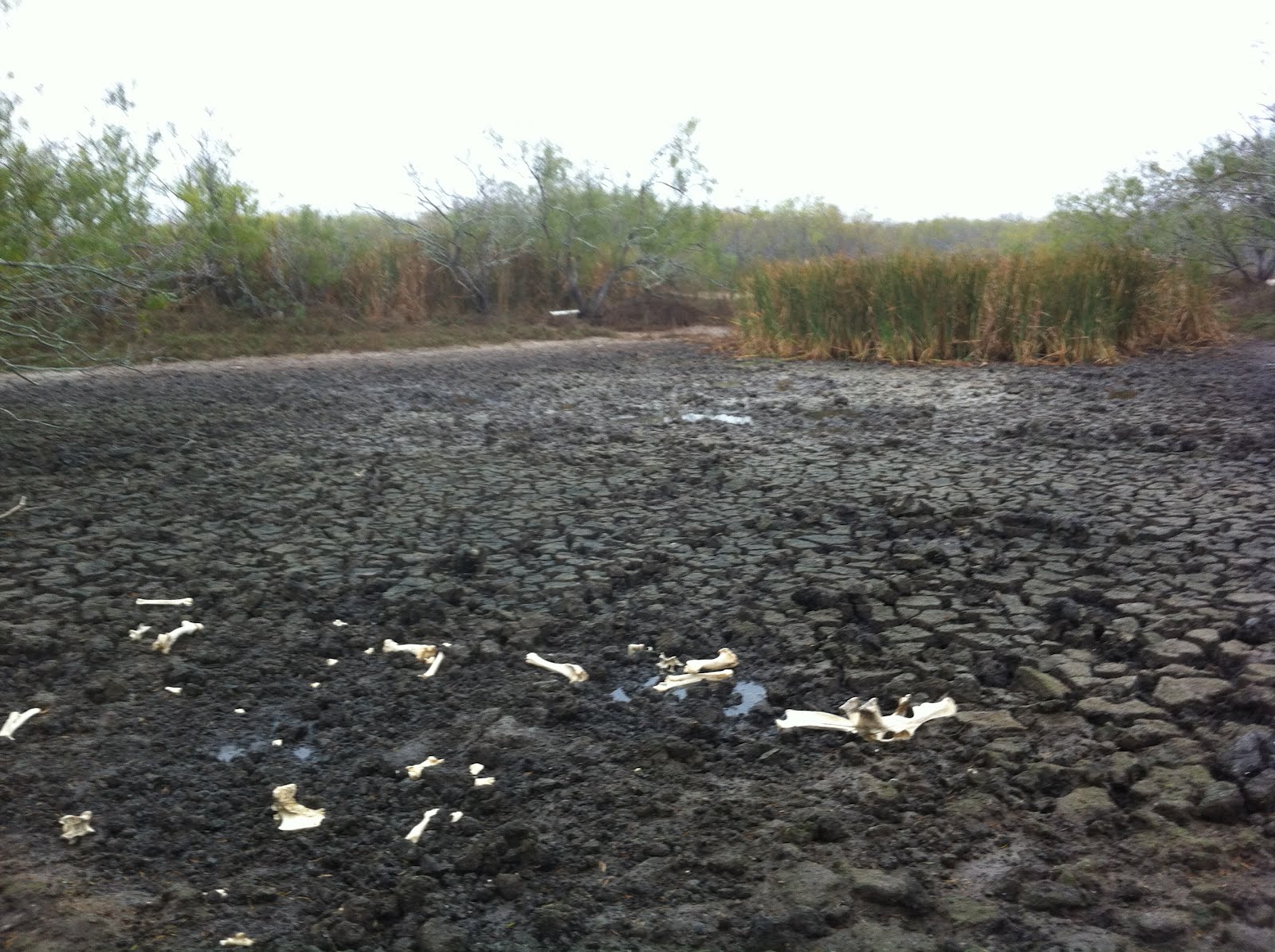
Here's some photos of tracks and signs at La Sal del Rey, USFWS NWR tract. I took these pictures while covering the area on the La Sal Vieja Christmas Bird Count. The salt lake was nearly dry, but was still heavily used for roosting by Sandhill Cranes, Greater White-fronted and Snow Geese. A freshwater spring held the skeleton of a nilgai, an introduced and established ungulate native to India. Nilgai can be more readily observed elsewhere; I've seen more dead animals at La Sal del Rey than live animals. Nilgai are common throughout south Texas.
The skull was partly broken. It was not nearly as heavy or large as a cow skull, but larger and stouter than a white-tailed deer.
Nilgai tracks were all over the lake shore.
Here's the tracks of a coyote on the beach. I watched a pair playing on the sand in the distance. A freshwater spring is the focus of wildlife activity in that saline and arid environment.
The coyote and nilagi tracks were overlapping on the beach. Nilgai are far to large to be prey for the omnivorous coyote, but all the animals were using the spring as a water source. Nilgai use communal feces piles. These are small fecal piles, but the largest I saw on the beach. They are always at the center of a web of tracks of nilgai coming and going. There were a lot more nilgai tracks, with calves skittering and bucking near cows. And yes, I did look up and find some birds, too!

Tuesday, January 3, 2012

Mountain Bluebird - Santa Ana NWR

Here's a couple of photos of the female Mountain Bluebird at Santa Ana NWR. The long winged profile (compared to Eastern Bluebird) is evident here, as is the sky-blue rump and tail. This is the first winter with Mountain Bluebirds in Hidalgo County since I moved here in 2006. The first birds found were a pair in San Juan that did not remain. There are several in western Hidalgo County as well.